Das Kolloquium „Politik von unten“ geht zurück auf die Initiative von drei Doktorand*innen. Es fand zunächst in den Jahren 2011 und 2012 mit Unterstützung der Berlin Graduate School of Social Sciences, des Arbeitskreises soziale Bewegungen der DVPW und des Wissenschaftszentrums Berlin für Sozialforschung ebendort statt. Seit 2013 ist das Kolloquium Teil des Institutsbetriebes.
Das Kolloquium soll ein Ort des regelmäßigen Austauschs über laufende Forschungsprojekte zu kollektivem politischem Handeln, politischer Mobilisierung, Protest, sozialen Bewegungen und Revolutionen sein.
Im Kolloquium „Politik von unten“ werden Forschungsprojekte und Texte zu kollektivem politischem Handeln diskutiert. Dies umfasst unter anderem die Themen politische Mobilisierung, Protest, soziale Bewegungen und Revolutionen. Beiträge aus verschiedenen Disziplinen sind ausdrücklich erwünscht.
Das Kolloquium soll einen gemeinsamen Ort für die verstreute Forschung zu einer Politik von unten schaffen, an dem konzentriert auf hohem Niveau diskutiert wird. Gleichzeitig soll es eine Möglichkeit sein, Forscher_innen mit ähnlichen Interessen regelmäßig zu treffen.
Der für zur Diskussion bestimmte Text wird im Vorfeld über eine separate Mailingliste verschickt und als bekannt vorausgesetzt. Diskutiert werden zum einen Entwürfe von Aufsätzen/Kapiteln (in der Regel vor der Publikation); zum anderen Forschungsprojekte, die den Entwurfsstatus überschritten haben. Die Diskussion orientiert sich an Tilly’s rules of etiquette. Die Arbeitssprache (DE – deutsch / EN – englisch) ist für jedes Datum einzeln festgelegt.
- The presented work has to be in progress. We explicitly exclude already finished articles, dissertations, and book chapters. The idea behind the colloquium is that the feedback given can still be incorporated into the work. The colloquium is not intended to be a promotional space or a forum purely for brainstorming.
- The “Politik von unten”-Colloquium aims to be an open and friendly space for exchanging ideas on work in progress. Hence, we explicitly encourage contributions from all career levels, ranging from advanced Master’s students (from the Master’s thesis onwards), to dissertation chapters, to article proposals.
- Please note that presenting at the colloquium comes with the expectation that you will also attend the other sessions and actively engage by providing feedback to your peers. The colloquium is based on reciprocity: it only works if everyone both gives and receives constructive feedback. Active participation in the other sessions is therefore an essential requirement for presenting.
- This is a paper-based colloquium. This means that you will need to provide a written text of no more than 20 pages by the time of your presentation. Please only apply if you are confident that you will be able to provide such a document by the time you present.
As soon as a Call for Participation for a new edition of the colloquium is circulated, you are welcome to submit a short abstract (around 200 words) of the work you would like to present. The call will be distributed via various mailing lists, including the colloquium’s own mailing list.
The abstract should be send toinfo (at) protestinstitut.eu and must include the following information:
- The title of your work, which will also be used in the colloquium’s promotional materials (e.g. social media posts, the programme, and flyers).
- A short overview of your core argument, method, and/or data.
- Your home institution.
- The type of academic contribution the presentation is for (e.g. article, book chapter, dissertation chapter, or dissertation/project outline).
- (Optional) Your preferred pronouns.
- Please indicate if you already know that you will not be available on any of the colloquium dates announced in the call.
After the submission deadline has passed, you will receive feedback on your application and, if accepted, be assigned a presentation date. We normally try to accommodate everyone who meets the formal requirements.
Absolutely! We explicitly welcome people who would like to attend only to listen and give feedback. This includes everyone who is interested, even if you are still studying.
We expect everyone who is presenting at the colloquium to attend the other sessions as well. However, if you are not giving a presentation yourself, you are very welcome to attend only the sessions that interest you.
All information about the colloquium is distributed via our mailing list. To register, send an email to politicsfrombelow-subscribe (at) lists.riseup.net and follow the instructions provided.
The schedule for each edition of the colloquium is also published on our website and on our Bluesky account. Individual sessions are additionally promoted on Bluesky approximately one week in advance.
Congratulations! We are looking forward to discussing your work.
Please make sure that you have registered for the mailing list by writing to politicsfrombelow-subscribe (at) lists.riseup.net and following the instructions. Please note that registering for the mailing list is absolutely essential for participation, as all relevant information will be distributed through it.
Your paper should be circulated via the mailing list approximately one week before your presentation. Please note that the email address used to send messages to the mailing list is different from the one used to subscribe. Make sure to send your paper to
politicsfrombelow (at) lists.riseup.net.
You will not receive a confirmation that your email has been sent or received. If you are unsure whether your email went through, please contact the organizers.
The Zoom link for each session will also be shared via the mailing list approximately one week in advance.
At the colloquium itself, you are expected to give a short presentation of your paper of no more than 20 minutes. A PowerPoint presentation is possible but not mandatory. The remaining 70 minutes are reserved for discussion and feedback.
Potentially, yes. The standard format of the colloquium is online. However, in the past we have also offered the possibility of holding presentations both in person at a host university and online. If you are interested in this option, please get in touch with the organizers as early as possible so that we can explore whether it can be arranged.
We explicitly ask all participants not to distribute any of the papers shared through the colloquium. Video and photo recordings during the colloquium are not permitted.
However, please be aware that the colloquium mailing list includes around 200 people. While this has not been a problem in the past, we cannot fully guarantee that papers will not be shared beyond the colloquium.
We therefore also recommend including a non-circulation note at the beginning of your manuscript, stating that the paper is a work in progress and should not be distributed without your permission.
Alle, die regelmäßig am Kolloquium teilnehmen wollen, können sich auf der Mailingliste eintragen über die Texte im Vorfeld verschickt werden. Die Registrierung ist möglich, indem eine Mail an politicsfrombelow-subscribe@lists.riseup.net geschickt wird. Wer zu einzelnen Sitzungen kommen möchte, verfolgt die Einladungen. Bitte stellen Sie sicher, dass unsere E-Mails nicht in Ihrem Spam-Ordner landen. Dies kann vorkommen, wenn Sie sich mit einer Universitäts-E-Mail-Adresse registrieren.
Zurzeit findet das Kolloquium überwiegend als Videokonferenz statt. Auch Hybridsitzungen sind möglich und werden gesondert spezifiziert.
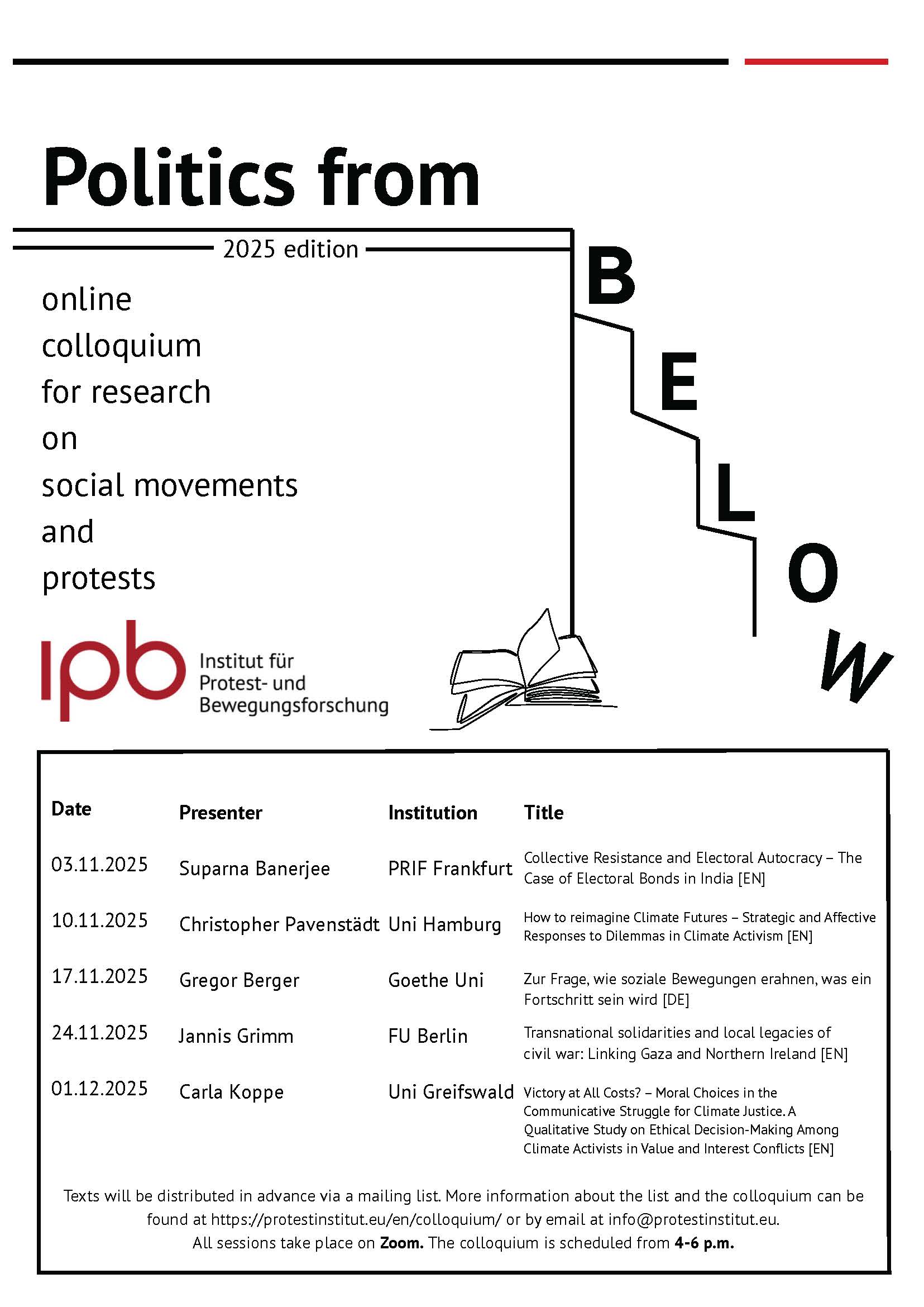
Das nächste Programm (2025/2026) wird organisiert von Damla Keşkekci, Eva-Lotte Schwarz, und Masha Guzzo.
Nächste
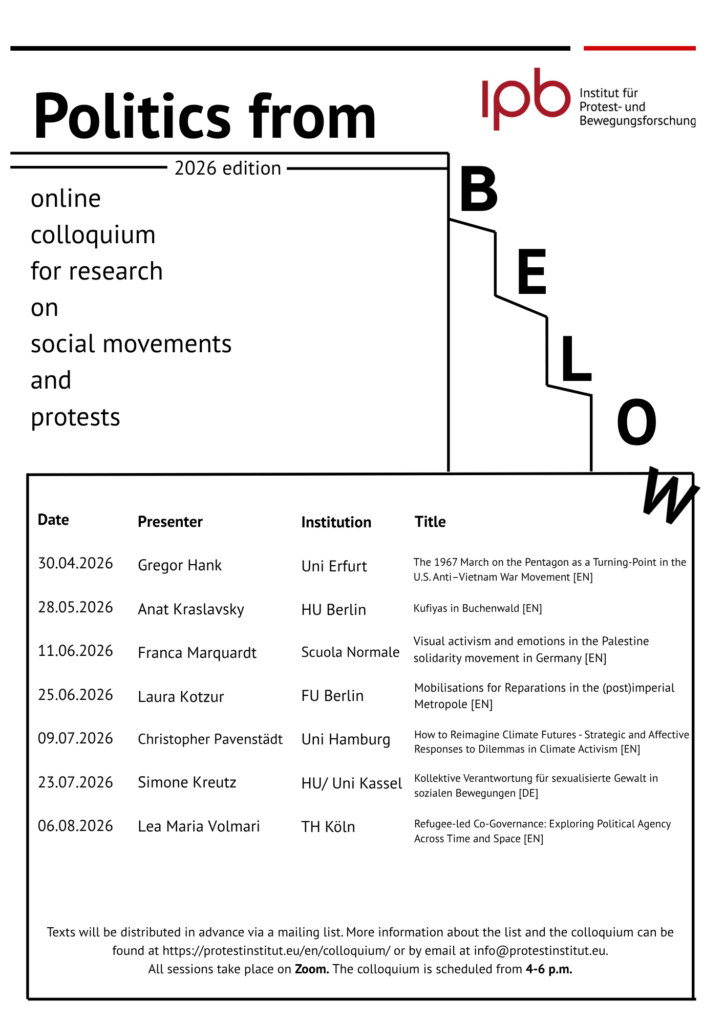
Archiv des Kolloquiums Politik von unten
- Programm Herbst/Winter 2025
- Programm Frühjahr/Sommer 2022
- Programm Herbst/Winter 2021
- Programm Frühjahr/Sommer 2021
- Programm Herbst/Winter 2020
- Programm Frühjahr/Sommer 2020
- Programm Frühjahr/Sommer 2019
- Programm Frühjahr/Sommer 2018
- Programm Herbst/Winter 2017
- Programm Frühjahr/Sommer 2017
- Programm Frühjahr/Sommer 2016
- Programm Herbst/Winter 2015
- Programm Frühjahr/Sommer 2015
- Programm Herbst/Winter 2014
- Programm Frühjahr/Sommer 2014
- Programm Herbst/Winter 2013
- Programm Frühjahr/Sommer 2013
- Programm Herbst/Winter 2012
- Programm Frühjahr/Sommer 2012
- Programm Herbst/Winter 2011
- Programm Frühjahr/Sommer 2011