– Institute for Protest and Social Movements Research
Understanding protest and social movements
Over 200 researchers work together at the ipb. They conduct joint research on current and past protests. They exchange ideas in working groups, workshops, and conferences. And they disseminate this knowledge to the public.
Protests are everywhere – they range from citizen initiatives against roads and development projects to revolts against authoritarian regimes; from street marches by radical supporters of the far-right to political messages sprayed on walls as graffiti. It is evident that these expressions of protest as well as public mobilisations by social movements are vital for democratic systems.
Yet, we still know little about their underlying dynamics: Who is drawn to street protests and who will rather choose other forms of resistance? Under which conditions are pro-democracy movements successful, when do they fail and why? How is the role of political organisations changed by the digitalisation of activism and by the fact that people increasingly communicate online? Which types of political activism are conducive to a democratic civic culture, and which ones actually further exclusion and discrimination?
These questions necessitate continued and systematic analyses. However, research on protest and social movements has mostly remained fragmentary and episodic. For the most part, studies of social mobilisation have been relegated to a niche existence within the social sciences.
The Institut für Protest- und Bewegungsforschung (ipb, Institute for Protest and Social Movement Studies) was founded with the intention to fill this gap. As a research hub it connects scholars from Germany, and beyond whose research is defined by a perspective on politics ‘from below’. This network aims to facilitate collaborative research projects in the spirit of public sociology and to contribute through its work to the development of sustainable solutions to pressing social issues of our times.
The mission of the ipb is to:
- conduct research projects and create expertise;
- connect scholars in the field and make their research visible;
- initiate public debates;
- act as a point of contact for everyone who is interested in academic expertise on protests and social movements.
If you would like to join our network, you can become an association member.
For further information, please contact the board members or our managing director at info(at)protestinstitut.eu.

Events

Events
Latest
Here you find English-language blog posts that include commentaries on the latest protest-related events and news about the Institute’s ongoing work.

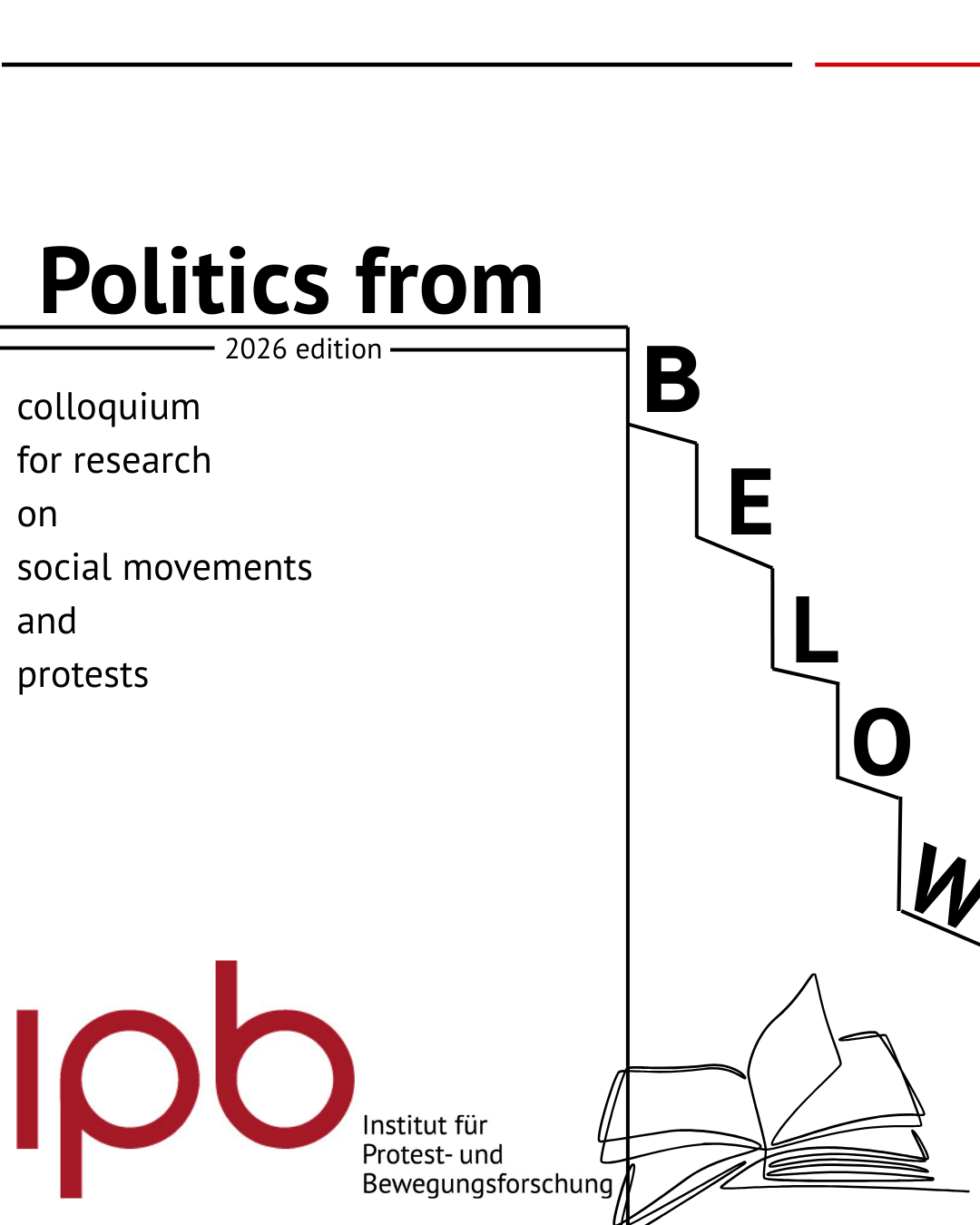
Call for Participation – ipb Online Colloquium “Politics from below” Spring 2026
Mehr erfahren: Call for Participation – ipb Online Colloquium “Politics from below” Spring 2026The Institute for Protest and Social Movement Research (ipb) warmly invites submissions for its colloquium
Workshop Report: Protest Policing in Hybrid Publics. Third Parties in Relation to Protest and Policing
Mehr erfahren: Workshop Report: Protest Policing in Hybrid Publics. Third Parties in Relation to Protest and Policingby Katharina Fritsch, Roman Thurn, Philipp Knopp – WG Social Movements and Police, Vienna 29.11.2024
20 Years of Protest Surveys: ipb publishes Protest Survey Data
Mehr erfahren: 20 Years of Protest Surveys: ipb publishes Protest Survey DataProtests are a pivotal form of political participation. They render social conflicts visible and they
Navigation and Activities
More information about the Institute, its activities, and members can be found in the pages below.
ipb in the Press
- This authoritarian masculinism – experts call it “protective masculinity” – requires a counterpoint: a weak woman worthy of protection who, in traditional patriarchal and heterosexual relationships, serves the man and of course can be sexually subjugated by him. Those of a right-wing authoritarian leaning thus seek to mobilise opposition to the neoliberal notion of women taking up employment, propagating instead traditional roles such as mother and housewife. It’s not only men who do this: female influencers who dub themselves “tradwives” (short for “traditional wife”) make their money from this latter model.
Development and Cooperation, 30.12.2025: The Chainsaw MenBirgit Sauer (Uni Wien)
The leading figures [of Generation Deutschland] come from a far-right milieu, in which former activists from the Identitarian Movement, fraternities, neo-Nazism and ethno-nationalist groups come together.
France24, 29.11.2025: German far right founds new youth wing in face of protests
Fabian Virchow (HS Düsseldorf)
“Whether you’re talking about the Communists, Yabloko or [the unregistered] Rassvet, at least they exist and they can do something,” Dollbaum told The Moscow Times. “Let’s take the Feminist Anti-War Resistance, one of the most courageous and numerous activist groups that are…very principally against the war and the regime. They [operate in Russia] anonymously…but they can’t currently be a real political actor,” he added.
The Moscow Times, 28.4.2025: Explainer: Does Russia’s ‘Systemic Opposition’ Still Exist?
Jan Matti Dollbaum (Université de Fribourg)
If climate activists foster alliances with trade unions and progressive corporations, a conservative-led government will have to deal with a powerful narrative.
dw.com, 13.2.2025: What’s next for Germany’s climate movement?
Simon Teune (FU Berlin)
A study of nonviolent action by Dalilah Shemia-Goeke finds that multinational corporations are deeply entangled with states in reciprocal relationships of dependence. While this puts constraints on the ability of states to regulate corporations, power imbalances between business and society can be redressed when people withdraw the support on which corporate entities depend.
Salon.com, 29.9.2024: Can we still prevent global catastrophe? Yes — by fighting corporate power, now
Dalilah Shemia-Goeke (Uni Marburg)