Protests are a pivotal form of political participation. They render social conflicts visible and they provide inside into the political attitudes that shape these conflicts. Who are the people, who engage in protests, and what drives them to take to the streets? While general population surveys allow for a superficial picture of protest participation only, event-related protest surveys provide more detailed information about the motives, attitudes, and sociodemographic characteristics of participants. The Institute for the Study of Protest and Social Movements has now systematically processed and harmonized a collection of 31 protest surveys from Germany and Poland. Through GESIS they are now made available to other researchers and the general public. Sebastian Haunss, Piotr Kocyba, Pascal Siegers, Marvin Stein, and Simon Teune report on the project.
All the data sets are available at GESIS.
Protests are moments when political conflicts become visible – e.g. for or against ambitious climate policy, for or against limiting immigration. But who are the people who take to the streets during protests? What are their motives and what differences are there between different groups of protesters? General population surveys can only provide vague answers to these questions. All long-term surveys, such as Allbus, the European Social Survey (ESS), GLES and the German Volunteer Survey (FWS), include questions designed to measure different forms of political participation. We thus know that, depending on the question, between 10 per cent (in the last year) and 20 per cent of the population (without time limitation) in Germany have participated in a demonstration. We can say what distinguishes these politically active people from other respondents (Weßels 2024, Wüst 2025). However, on this basis, we cannot say anything about which protests people have participated in, why they did so, and how the motives and attitudes of demonstrators differ between different protest events (see, however, Borbáth 2024).
This knowledge gap can be filled by demonstration surveys. People are surveyed at the moment and in the place where they are politically active – at the demonstration itself (on the method, see e.g. Della Porta & Andretta 2014, van Stekelenburg et al. 2012). The Institute for Protest and Movement Research (ipb) is a self-organised association of more than 200 social scientists, who have repeatedly applied and improved this method since 2003. Now, the ipb protest researchers are making a large part of the data collected in this way available for research and teaching via GESIS (Haunss et al. 2025). This gives researchers access to the most comprehensive collection of standardised protest survey data in the German-speaking world. At the same time, data from 19 demonstration surveys in Poland conducted between 2018 and 2021 by Piotr Kocyba as part of the BMBF-funded project ‘Civil Society Unrest in Poland: A Comparative Analysis of Current Protests’ (funding code FKZ 01UL1816X) is being published. This means that data from more than 30 demonstration surveys will be made available.
The published data covers a period of 20 years, ranging from the protests against the Iraq War in 2003 to the climate strikes in 2023. In terms of content, it covers topics such as peace and climate, as well as criticism of globalisation, social policy and infrastructure projects. The surveys in Poland also took place during demonstrations against restrictions on fundamental democratic rights by the former government. The questionnaires distributed at the demonstrations mainly cover questions on political attitudes and demographics, but they also address mobilisation channels (how did the respondents find out about the demonstration? Who are they there with?) and political activities. In addition, each data set contains an open-ended question about motivation for participating in the demonstration and other event-related questions.
The method of conducting surveys at demonstrations is adapted to the unpredictable protest events. It is not possible to reliably predict whether a demonstration will mobilise large numbers of people and whether it will gain momentum in the public debate. Sometimes the weather alone prevents broad participation. Under these uncertain conditions, a large part of the surveys were conducted by spontaneously formed research teams who prepared the survey of a demonstration in a few weeks or even days with few resources and a large amount of unpaid work. Processing and publishing the data beyond an initial report usually fell short due to limited resources, and the documentation remained incomplete. In addition, the underlying questionnaire was repeatedly modified by the various research teams.
Therefore, this treasure trove of data had to be standardised before publication and the documentation of the data had to be reconstructed. In addition to the questionnaires in their original languages (German or Polish), English-language data sets and methodology reports were produced in order to appeal to the international community. This work was made possible by project funding from KonsortSWD, the social and economic sciences consortium in the National Research Data Infrastructure (NFDI). For dataset publication, the questions were standardised as far as possible across all surveys in collaboration with the Research Data Centre of the General Population Survey for the Social Sciences (FDZ ALLBUS), and all data that could potentially have identified the respondents was removed or aggregated. The methodology reports for the individual surveys provide information about the circumstances under which the data was collected and also contain details about the demonstrations at which the survey was conducted.
Over the last five years, a core questionnaire for use in demonstration surveys has been developed and is being used by researchers at the Institute for Protest and Social Movement Research. It contains a series of standard instruments, in particular questions on motivation and mobilisation to participate and a demography module. Based on the project work on the publication of the demonstration surveys, the uniformly assigned variable and label names are now also available in a sample questionnaire. This means that future survey data can also be prepared for reuse.
The data now published allows us to take a snapshot of political conflicts. The surveys give a voice to those who shape public debate with these events. Based on this data, questions can be answered that shed light on individual protests, but also on the various conflicts or waves of protest in comparison. How does trust in institutions and the experience of self-efficacy differ between Fridays for Future and Pegida (Daphi et al. 2023)? How do attitudes towards climate strikes change over time (Sommer et al. 2020)? Do the attitudes of protesters differ between two demonstrations organised by different alliances for the same cause (Sommer & Haunss 2023)? Do the causes of the demonstrations allow conclusions to be drawn about those gathered there (Dollbaum et al. 2025)?
The survey data can also be used to understand the positions of activists in specific conflicts. It provides insight into the relationship between party politics and protest politics or the self-perception of the political left and right in Germany.
References
Borbáth, E. (2024). Differentiation in Protest Politics: Participation by Political Insiders and Outsiders. Political Behavior, 46(2), 727–750. https://doi.org/10.1007/s11109-022-09846-7
Daphi, P., Haunss, S., Sommer, M., & Teune, S. (2023). Taking to the Streets in Germany – Disenchanted and Confident Critics in Mass Demonstrations. German Politics, 32(3), 440–468. https://doi.org/10.1080/09644008.2021.1998459
Della Porta, D., & Andretta, M. (2014). Surveying Protestors. Why and How. In D. della Porta (Hg.), Methodological Practices in Social Movement Research (S. 308–334). Oxford University Press. https://doi.org/10.1093/acprof:oso/9780198719571.001.0001
Dollbaum, J. M., Meier, L. D., Daphi, P., & Haunss, S. (2025). Protest types and protester profiles: Testing meso−micro-associations between event characteristics and participant attitudes. Acta Politica, 60(3), 621–647. https://doi.org/10.1057/s41269-024-00345-7
Haunss, S., Kocyba, P., Siegers, P., Teune, S., Stein, M., & Baumann, H. (2025). 20 Jahre Protestbefragungsdaten. Abschlussbericht. KonsortSWD. https://doi.org/10.5281/zenodo.17777997
Sommer, M., & Haunss, S. (2023). Grenzen von Protest: Auswertungen von G20-Demonstrationsbefragungen. In S. Malthaner & S. Teune (Hg.), Eskalation. G20 in Hamburg, Protest und Gewalt (S. 121–135). Hamburger Edition. https://doi.org/10.38070/9783868549997
Sommer, M., Haunss, S., Gardner, B. G., Neuber, M., & Rucht, D. (2020). Wer demonstriert da? Ergebnisse von Befragungen bei Großprotesten von Fridays for Future in Deutschland im März und November 2019. In S. Haunss & M. Sommer (Hg.), Fridays for Future—Die Jugend gegen den Klimawandel Konturen der weltweiten Protestbewegung. (S. 15–66). Transcript. https://doi.org/10.14361/9783839453476
van Stekelenburg, J., Walgrave, S., Klandermans, B., & Verhulst, J. (2012). Contextualizing Contestation: Framework, Design, and Data. Mobilization: An International Quarterly, 17(3), 249–262. https://doi.org/10.17813/maiq.17.3.a4418x2q772153x2
Weßels, B. (2024). Politische und gesellschaftliche Partizipation. In Sozialbericht 2024: Ein Datenreport für Deutschland (S. 345–352). Bundeszentrale für politische Bildung. https://www.bpb.de/system/files/dokument_pdf/Sozialbericht_2024_bf_k2.pdf
Wüst, A. M. (2025). Nähe oder Distanz? Eine Analyse der politischen Partizipation von Menschen mit Einwanderungsgeschichte in Deutschland. Zeitschrift für Politikwissenschaft, 35(2), 407–437. https://doi.org/10.1007/s41358-025-00408-x
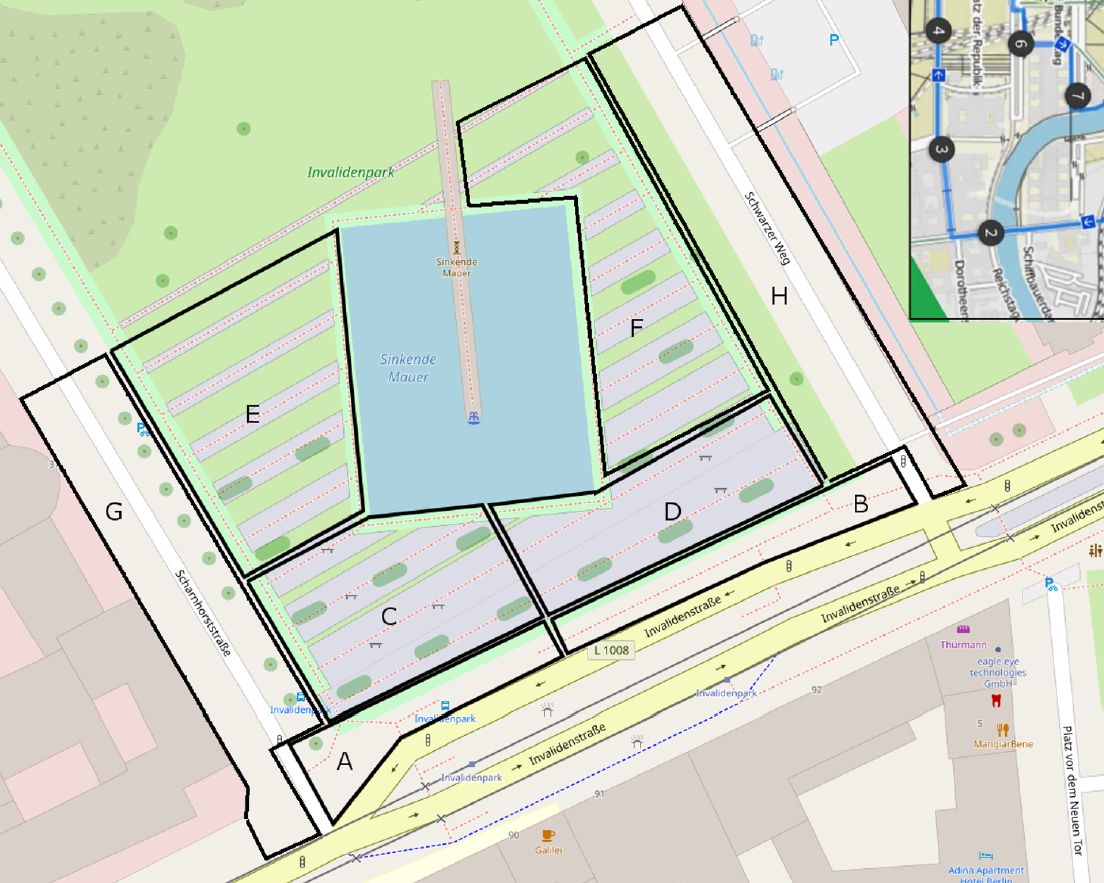
Picture: Survey sectors for the protest survey at the Fridays for Future demonstration on 15.3.2019 in Berlin.