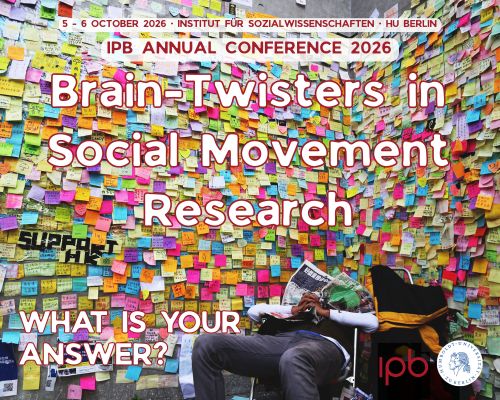
Brain-Twisters of Social Movement Research | Berlin, 5 and 6 October 2026
Research on protests and social movements is characterised by recurring puzzles – open questions that arise repeatedly across cases, methods and theoretical traditions. While we have accumulated rich empirical knowledge, many core issues remain contested, conceptually unsettled or dependent on context. Rather than viewing these disputes as a shortcoming, this conference invites participants to recognise them as productive starting points for collective thinking.
The Format
The Institute for the Study of Protest and Social Movements (ipb) organized its 2026 annual conference in an experimental format. Instead of conventional panels that bring together several but often unconnected papers under a shared theme, each session was organized around one clear-cut question. Each speaker was expected to provide a concise answer, i.e. a brief contribution based on their own research, literature review, empirical case studies, data or methodological expertise.
In order to minimise the usual trade-offs between parallel sessions, the conference ran with a maximum of two parallel panels at any one time. Each 90-minute panel included two to four speakers. Contributions were brief, leaving ample time for discussion. The panels followed a fishbowl-inspired format, in which members of the audience were invited to join the discussion by taking a reserved seat and providing a brief response to the guiding question or offering their own perspective and/or research-based comments on the speakers‘ answers.
The Venue
The 2026 ipb annual conference was held at the Institute for Social Sciences at Humboldt University Berlin, Universitätsstraße 3B, 10117 Berlin.
The discussions took place in two rooms, we marked as ⌂ (home) and ◇ (diamond). All rooms are on the ground level.
The Program
Monday, 5 October 2026
starting 12:30 Registration
1:15 – 1:30 Welcome and introduction ⌂
Organizing Team
1:30 – 3:00 Session 1: What are we talking about when referring to social movements? ⌂
- Or Yosefov (Humboldt University of Berlin): Contemporary social movements could evolve into a civil society of war whose involvement in violent conflict both reproduces and constrains war
- Thalles Breda (Federal University of São Carlos): From social movements to collective networks? Hybrid organizational forms and strategies of mobilization in contemporary Brazil
- Kai Heidemann (Maastricht University): When we talk about social movements, we’re talking about educational agency
- Dieter Rucht (Institute for the Study of Protest and Social Movements): Social movements are a product of modernity, based on the idea that society can be created and changed by human beings
Facilitation: Johanna Raphaela Wahl (University of Oldenburg)
3:00 – 3:15 Break
3:15 – 4:45 Session 2: Does (state) repression work – even in the long run? Part 1 ⌂
- Lisa Voigt (Hertie School of Government): Long-term demobilization of SMs can result from the consolidation of repressive frames in parliaments and courts, but contestation can also disrupt delegitimization
- Ruth Simsa and Julia Litofcenko (both Vienna University of Economics and Business): Yes, and it already starts with negative narratives and delegitimizing media discourses
- Merel Driessen (Erasmus University Rotterdam): State repressions ‘works’ when informalized towards legitimation
- Katharina Fritsch (University of Vienna): Repression hits emotionally and can produce both mobilizing and demobilizing effects
Facilitation: Philipp Knopp (Technische Universität Chemnitz)
3:15 – 4:45 Session 3: Global North South cooperation: Under what conditions does de-solidarisation occur, why do alliances break, and what can be done about it? ◇
- Antje Daniel (University of Vienna): Cooperation requires confronting climate coloniality, as power imbalances and hierarchies reproduce exclusion even within solidarity-driven alliances
- Nicole Milman-Doerr (University of Siegen): Cooperation depends on how activists imagine each other. Political imaginaries are contested and unstable, but can be renegotiated through transnational dialogue and encounter
- Sabrina Zajak (Catholic University of Applied Social Sciences Berlin): Cooperation remains possible, but fragile as it is constantly undermined by internal conflicts, shrinking resources, and ideological polarisation that erode even long-standing alliances
- Phoebe Sanchez (University of the Philippines Cebu): The current global political economic order puts genuine solidarity into multiple twists and turns making it hostage to an uncertain future. It is unfortunate to say that there is still much to be desired when we speak of solidarity, interdependence, mutual support, cooperation, equality and /or common benefit in today’s interstate arena
Facilitation: Ceren Çevik (University of Siegen)
4:45 – 5:15 Break
5:15 – 6:30 Plenary panel discussion: What is the impact of AI on social movements? ⌂
Speakers: Philipp Knopp (Technische Universität Chemnitz), Can Şimşek (Humboldt Institute for Internet and Society), Lisa Bogerts (Institute for the Study of Protest and Social Movements)
Facilitation: Mareike Bauer (European University Viadrina Frankfurt)
Tuesday, 6 October 2026
9:15 – 10:45 Session 4: How do social movements die? ⌂
- Jannis Julien Grimm (Freie Universität Berlin): Mass movements die because of burnout, adaptation, and infighting
- Ann-Kirstine Rønn (Aarhus University): Diaspora movements die when they fail to cater to the diaspora community
- Myriam Ahmed (Freie Universität Berlin): Revolutionary movements die when external and internal factors change the realities and priorities of key mobilizing actors
- Endre Borbáth (University of Heidelberg): Social movements die when their participatory infrastructure stops converting grievances and sympathy into meaningful collective voice
Facilitation: Jannis Julien Grimm (Freie Universität Berlin)
10:45 – 11:00 Break
11:00 – 12:30 Session 5: Does (state) repression work – even in the long run? Part 2 ⌂
- Sofia Rolim (University of Bergen): Repression works when it hides: Politics of visibility in legal prosecution
- Clemens Arzt (Berlin School of Economics and Law): Freedom of expression and assembly: Access to justice in Germany offers very limited remedies, if any
- Julia Schreiber (University of Sussex): Repression can spark transnational solidarity (depending on who represses and gets repressed)
Facilitation: Katharina Fritsch (University of Vienna)
11:00 – 12.30 Session 6: What power do objects and symbols hold in social movements? ◇
- Lior Ayali: Social movement objects gain power when they become totems that organize belonging, obligation, and collective identity
- Nicole Milman-Doerr (University of Siegen): How visual images have polarized a global Left, and on limits and strengths of critical visual image work
- Simon Teune (Freie Universität Berlin) Symbols are shortcuts to movement messages and identities. Their power rests in shared practices
- Lisa Bogerts (Institute for the Study of Protest and Social Movements) Images allow movements to communicate their world-views in subtle and ambiguous ways and thus to employ diverse persuasion strategies
Facilitation: Johanna Raphaela Wahl (University of Oldenburg)
12:30 – 2:00 Lunch break
2:00 – 3:30 Session 7: Can social movements in the Global North and South overcome hurdles to cooperate? ⌂
- Marie-Sophie Borchelt (University of Bielefeld): Yes, since transnational exchange can transform how movements organize, strategize, and understand their struggles
- Zozan Baran (Freie Universität Berlin): Yes, but only if we first acknowledge the real barriers to doing so
- Felix Anderl (University of Marburg): It hinges on the capacity of movements to build and endure solidarities across difference. There are ways to achieve this, but more often than not, they fail
Facilitation: Eva-Lotte Schwarz (Scuola Normale Superiore)
2:00 – 3:30 Session 8: Will social movements be able to throw a wrench in the works of fascism? ◇
- Janne Frederike Fenz (Karlstad University): Practices of constructive resistance are crucial for the sustainability of antifascist countermobilization
- Peter Nikolaus Funke (University of South Florida): Hopefully if they help lead a broader „popular front”
Facilitation: Simon Teune (Freie Universität Berlin)
3:30 – 3:45 Break
3:45 – 4:45 Concluding discussion: What is the responsibility of protest research in authoritarian times? ⌂
Inputs by Jannis Grimm (Freie Universität Berlin), Clara Tempel (activist and independent scholar), Swen Hutter (Freie Universität Berlin/Berlin Social Science Center)
Facilitation: Marvin Stein (University of Leipzig)
How To Get Involved / Registration
Initial inputs with contributions to the discussion have been selected following a Call for Answers (see conference program).
Resistration is now closed. If you have not done so yet, please transfer the participation fee (60 Euro, 10 Euro reduced fee) to the following account:
Verein für Protest- und Bewegungsforschung
IBAN: DE90430609671147040300
BIC: GENODEM1GLS (GLS Gemeinschaftsbank eG)
Payment reference: ipb conference 26 [regular/reduced] fee [your surname]
A receipt will be available at the conference registration desk. You can also scan the respective QR Code with your banking app.


Organizing team
For any question, please contact the organizing team by Email: conference@protestinstitut.eu
Dieter Rucht, Eva-Lotte Schwarz, Marvin Stein, Simon Teune, Johanna Raphaela Wahl